
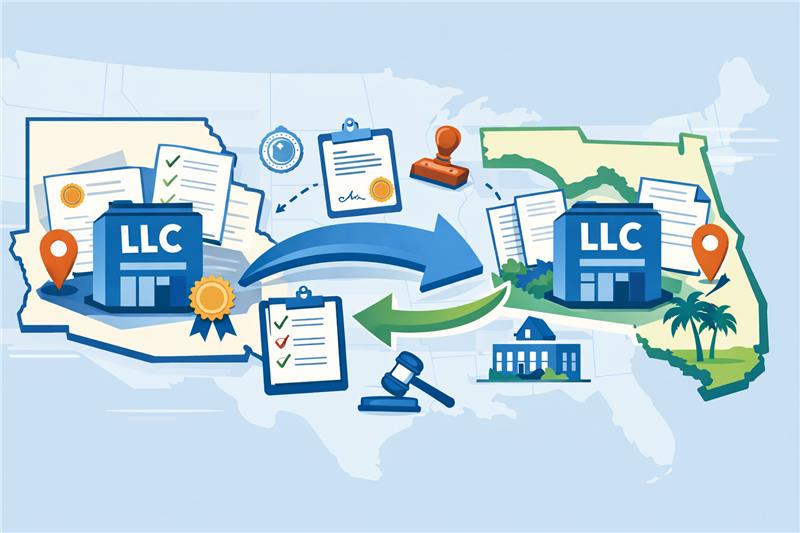
How to Move an LLC to Another State (Without Creating Legal Problems)
Entrepreneurs move for all kinds of reasons. Sometimes it’s a tax advantage. Sometimes it’s better business opportunities. Sometimes it’s simply where life takes them.
But if you own a limited liability company, relocating raises an important legal question:
What happens to your LLC when you move to another state?
The answer is simple in theory but nuanced in practice.
An LLC is a creature of state law. When you form an LLC, it becomes legally “domestic” in that state and “foreign” everywhere else.
That means moving your business operations doesn’t automatically move the entity.
Let’s break down the four primary options.
Option 1: Foreign Qualify Your LLC
This is the most common solution.
Instead of moving the LLC itself, you simply register it to do business in the new state.
Your company remains a domestic LLC in its original state, but it becomes a foreign LLC in the new state.
To do this, you typically must:
- File a Certificate of Authority
- Appoint a registered agent in the new state
- Pay filing fees
- Maintain compliance in both states
For example:
A real estate investor forms an LLC in Florida but starts buying property in Georgia. Rather than creating a new company, they simply foreign qualify the Florida LLC in Georgia.
The downside?
You now have two sets of compliance requirements — annual reports, fees, and possible taxes in multiple states.
For some companies, that’s manageable. For others, it becomes inefficient.
Option 2: Domestication (Statutory Conversion)
Domestication is often the cleanest option — when available.
In a domestication, the LLC legally transfers its home state from one jurisdiction to another.
Think of it like changing your driver’s license when you move states.
The entity itself remains intact. It simply changes where it is legally domiciled.
Advantages include:
- Maintaining the same EIN
- Preserving contracts
- Keeping the same business history
- Avoiding multiple state filings
However, domestication only works if both states allow the process.
Many states now permit this, but not all.
Option 3: Create a New LLC and Merge
Another strategy is forming a new LLC in the destination state and merging the original entity into it.
This is often called a statutory merger or reorganization.
The process usually involves:
- Forming a new LLC
- Drafting a merger agreement
- Filing merger documents with the state
- Transferring assets and liabilities to the new entity
This approach preserves business continuity but requires more legal work.
Option 4: Dissolve the Old LLC and Start Fresh
The final option is simply shutting down the old entity and creating a new one.
This means:
- Dissolving the LLC in the original state
- Paying any outstanding taxes
- Forming a brand-new LLC in the destination state
This is typically the least attractive option because it can disrupt:
- Contracts
- Banking relationships
- Licenses
- Financing agreements
It also eliminates the company’s legal history.
Common Reasons Businesses Move Their LLC
There are several practical reasons entrepreneurs consider relocating their LLC:
1. Relocation of headquarters
The owner or management team moves.
2. Tax planning
Some states have more favorable business tax rules.
3. Regulatory advantages
Certain states have business-friendly legal frameworks.
4. Asset protection strategies
Entrepreneurs sometimes restructure their entities to improve liability protection.
This is particularly relevant when working with a Florida asset protection attorney or Florida business attorney.
Florida-Specific Considerations
For businesses operating in Florida, entity structuring often overlaps with:
- Florida LLC and asset protection strategies
- Real estate ownership planning
- Business succession planning Florida
Real estate investors frequently combine:
- LLCs
- Land trusts
- Holding companies
A Florida real estate lawyer can help design structures that maximize liability protection while minimizing administrative complexity.
FAQ
Can I just move my LLC address?
No. Changing your business address does not change your LLC’s state of formation.
Do I have to dissolve my LLC to move it?
Not necessarily. Domestication, merger, or foreign qualification often avoid dissolution.
Can I keep my EIN?
Yes — in most domestication or merger scenarios.
However, dissolving and forming a new LLC may require a new EIN.
Do I need an attorney?
For simple moves, filing services can handle the paperwork.
But if your business owns real estate, has investors, or has liability exposure, legal advice is essential.
Final Thoughts
Moving an LLC across state lines is more than just paperwork.
It affects:
- Liability protection
- Taxes
- Compliance
- Business continuity
The right strategy depends on your business model, your assets, and the laws of both states.
Working with a Florida business attorney or Florida asset protection attorney like our firm can help ensure the move strengthens your structure rather than creating hidden risks.
Review Your LLC Structure Before You Move
If you're considering changing states, don't assume the simplest filing choice is the safest one. Let’s review your LLC structure and discuss the legal, tax, and asset protection options available to you.
Book a ConsultationGet the Free Decision Guide
Download Florida Real Estate Investors: Should You Move Your LLC? Decision Guide to better understand the practical considerations before you change your entity structure.
Download the Free Guide