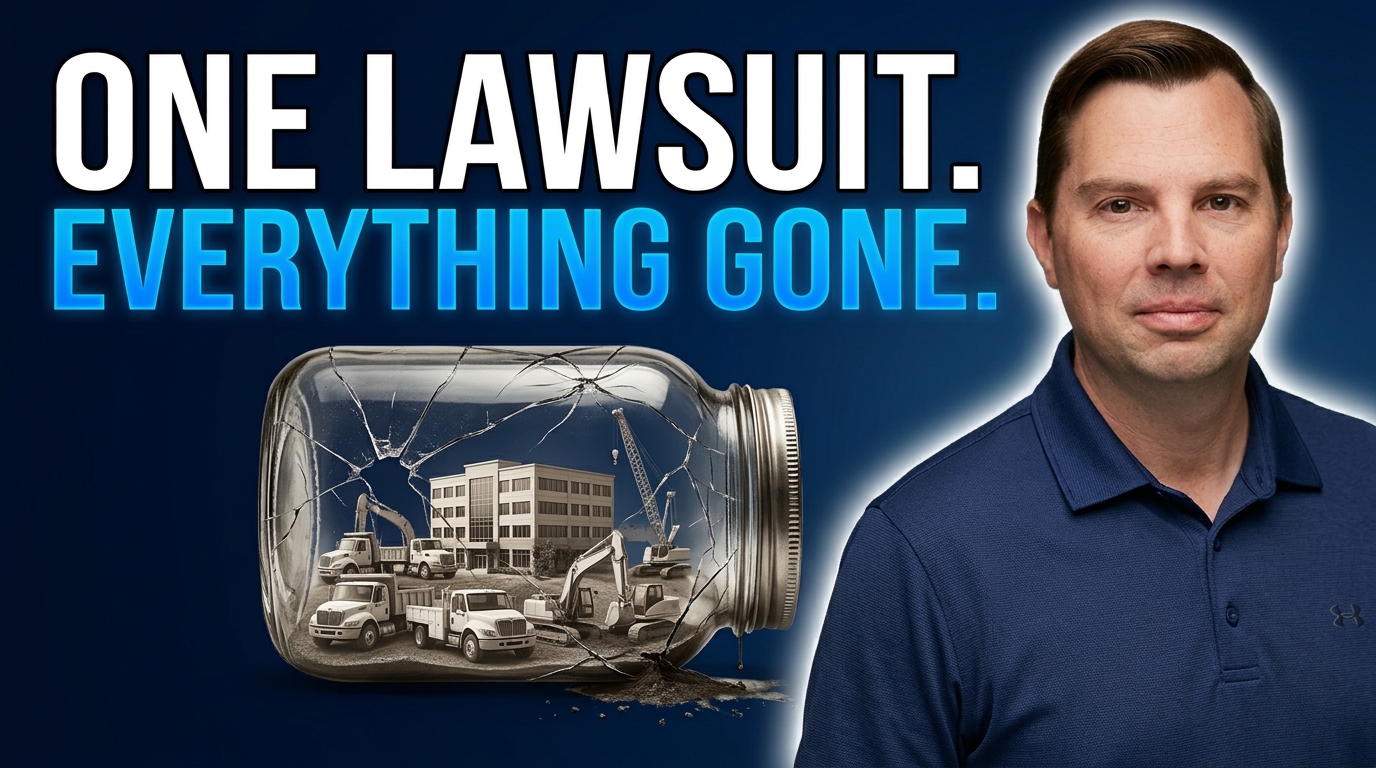
Asset protection for home service businesses starts with one question: what happens to everything you own if a single lawsuit hits? Electricians, roofers, pool companies, painters, general contractors, and home flippers often hold their trucks, equipment, real estate, employees, and intellectual property inside one business entity. Even with strong insurance, a company running several service trucks every day will eventually face a car accident claim, and most established businesses have dealt with a contract dispute or a costly long-term vendor agreement. When all of those assets sit in the same company, one claim can put the entire business at risk.
In this episode of Trust This, Florida Asset Protection Attorney Joe Seagle explains how entity structuring helps business owners compartmentalize risk. Instead of one company owning everything, separate LLCs can hold the trucks and heavy equipment, the office or warehouse real estate, and any patents or intellectual property, while an employee leasing company manages the workforce, payroll, and workers’ comp. The operating business then leases equipment, pays rent, and licenses intellectual property from each entity, and every company signs only its own contracts and pays its own bills. It’s the same principle Aspire Legal Solutions applies to Florida land trusts, where each property sits in its own trust so that if one falls, that’s all that falls.
Joe also covers the tax flexibility a multi-entity structure creates, from passive rental income on business real estate to choosing C-corp, S-corp, or partnership tax treatment for each LLC with the help of a CPA. He explains why business owners in their 30s and 40s, when growth is at its peak, should build this structure now, and why owners nearing retirement may reasonably choose to keep things simple.
Watch the full episode of Trust This to learn how to protect your business assets, limit lawsuit exposure, and put fewer eggs in each basket.
Transcript
I just want to talk today a little bit about entity structuring because we’ve got a lot of our clients are home service business owners that are electricians and pool companies and roofing companies, folks like that, painting painters, general contractors. So they have a lot of equipment, also home flippers for some reason. You guys have a lot of equipment too. But one of the things I’ve noticed is
You typically own your real estate, all your equipment, all your intellectual property, everything is owned in one business company.
And it’s come up a lot because especially for those of you who have a lot of trucks on the road, maybe they’re repair trucks or service trucks, and those are all titled in the business. And of course you’ve got great insurance, you carry great insurance, but anybody who has a business who has more than three or four trucks on the road every day.
Has experienced the dreaded lawsuit, the car wreck lawsuit. Also, most business owners have, if you’ve been in business any length of time, you’ve you’ve experienced the dreaded lawsuit from property damage, breach contract. Maybe you signed a contract for billboards, maybe you signed a contract for wrapping those cars, maybe you signed a big SEO contract.
For multiple months or years, and it’s just not working out. It’s not bringing in the business. Back in the day, we saw this a lot with the yellow pages when the internet and Google came along, and all of a sudden everybody started stopped using yellow pages to find a service provider, whether it’s a lawyer or doctor or electrician or whatever, and started just using the internet to Google it. A lot of folks had signed multi-year 100,000.
hundreds and hundreds of thousands of dollars of for advertising in yellow pages. So they got stuck with that and they ended up having to declare bankruptcy to make those debts go away. Billboards was another one. We we saw that a lot back in the day. People spent a lot of money on billboards and signed huge marketing contracts for that and then just ended up having to declare bankruptcy to make them go away. So for that reason I learned long ago
That it’s really important to compartmentalize your businesses. And what I mean by that, not only for asset protection issues, but also for tax issues. So, for instance, you would own the trucks, and maybe only the trucks at certain locations or one location, all the trucks that you know would be owned by one entity, and that entity
Then leases every month the trucks to the the operating entity. So you got your your equipment entity that owns the trucks, maybe another entity if you got very big equipment of some type that owns that other equipment. And then you have your operating business that operates the business. It it owns the accounts receivable, it owns the the logo, the name,
and the intellectual property of the company. Now if you’ve got patents, you would typically have another company that owns the patents and then licenses the patents to the operating company. Another thing, this is probably the most common that people do all the time and they don’t even think about it, but they own another they have another company that owns the real estate where the offices are or where the the warehouses are or where the shops are. So they’ll have
maybe one or two or three entities that own the real estate. And then the operating business pays rent to that company. Another one you can have is you could have another entity that le owns your employees. It’s it’s a it’s an employee leasing company and it owns the employees. It handles all the benefits, workers comp, everything for all the employees, and then it leases the employees to the operating entity.
And the entity that owns that holds the licenses. And then what you try to do is you have each of those entities are only signing agreements for what they have to do. So the real estate entity is signing the agreement to borrow the money to buy the the office building or the shop or the warehouse. And of course it may be guaranteed by the operating entity and even you personally, typically, but at least it’s
over there and it’s away from the operating entity. You have another entity that is signing the financing agreements to buy all the trucks and the big equipment in the other oper in that other entity. So you’re you’re you’re shielding each of those away from each other. And then you have the operating entity that is signing leases, it’s signing employment agreements, service agreements, employment service agreements with
the employee leasing entity. It’s signing a lease with your real estate entity. It’s signing leases for the equipment with that. And then every month as money comes in, it then separates and pays out those companies and then those companies pay their bills. So that is really, you know, the way that I’ve often told our clients to set up. A lot of clients go, yeah, but think it’s very complicated. And I go, well, yes and no.
For instance, the real estate, yes, you’re probably gonna have that entity that’s holding that’s probably gonna be an LLC or land trust. It’s gonna have one member or or one beneficiary or multiple and so it’s gonna have its own tax return. It’s gonna have a a probably a ten sixty-five tax return for that entity that owns the real estate because and it’s gonna pass through that way. And it’s gonna be taxed as passive income because it’s just getting rent.
from renting the real estate to your operating entity. The operating entity may be a C Corp so that it can play with its tax year, so that it can, if you ever decide to sell that business off in the future, maybe you’re going to sell it and it’s it’s going to be sold in a way that you can take advantage of the qualified small business sale and you won’t have any capital gains tax on it because it was taxed as a C Corp. It has to be taxed as a C Corp for at least five years before you sell it. Maybe you can do that.
The company that owns the trucks and and the equipment, depending on how those are depreciated, that may be taxed as a as a disregarded entity, maybe taxed as a partnership, maybe taxed as a C Corp, maybe taxed as an S-corp. Your s your CPA could help you with that. And of course, you’ve got your employee leasing company. And if you’re setting that company up to where it’s actually making a little bit of profit from managing all the employee benefits and managing the employees, the hiring, the firing, and everything else that goes along with that.
Maybe that’s an S-corp, so that you get some benefit there for that. So you can play with your different tax structures as well, even though every one of those entities may be an LLC, you’ve still got that flexibility that you can elect to have them taxed as a corporation or a partnership or a corporation that’s taxed as an S corporation. So you’ve you’ve got a lot of more flexibility there from a tax standpoint as well.
Now a lot of my clients, they’re getting older, they’re getting later in years, they’re like me, been doing this 30 years, heading into 40, and they’re they’re like, I don’t want to get that complicated. That’s fine. If everything’s working fine for you and you’re happy with it the way it is, leave it the way it is. But usually if I’ve got clients that are in their thirties or forties and their business is really rocking and rolling and and in your thirties and forties is when you’re really gonna make most of your growth and your money. Once you hit your fifties, you sort of
most people hit sort of a plateau and sort of just s coast at that point. They they still have growth and they still do well, but they’ve by then by your fifties, you you’ve usually got your business set up to a point that it just it just runs without you and you and it’s simple and you don’t want to complicate things. But if you’re in your thirties and forties and you’ve got a business and it’s really starting to grow and go, always keep in mind, hey, maybe I don’t want this
asset this liability inside this this one over here. I don’t want to carry them all in the same bucket. I want to separate them. And I preach this for years with land trusts where it’s each property is in its own separate land trust. So it’s separated away from each other and away from the true owner. And so if one falls, that’s all that falls. This is sort of that same concept, except with it’s not real estate, it’s business, business structures.
And it’s a way that you’re putting as few eggs in each basket as possible. And just definitely something to think about. Let me know what you think down below if you’re early on in your your growth of your business and in your career with your with your entrepreneurial business. Let’s hear about it. You know, tell me how that’s going for you. if you’re okay with the complexities or if you if you’re trying to keep it simple too.
I know a lot of things now with AI. it’s able to keep things a lot more simple than it was when I was in my 30s and 40s. but you still, especially home service businesses, you have to have human beings who will climb up on that roof, who will sling that paintbrush and who will run those wires and and lay those pipes. AI, so far, we don’t have robots that do that yet. so it’s definitely something to be thinking about.
And and I want you to think about it. Let us know if you’re late in your career and you’re just trying to keep things simple and and you’re you’re sort of winding down into retirement. or if you’re winding up to sell. You’re you’ve scaled up to a point where you’re like, hey, I think I could sell this off to a millennial or even a Gen Z who may want to make a go of their own business and they can finance it and they can buy it from me and we’ll all be happy. let us know about that.
and how that’s working for you. otherwise, it’s great to see everybody. I hope you all have a great rest of your week and until later, Trust This.
📧 Have a question you want answered on our next Ask Joe episode? Leave a comment below!
📬 Subscribe: Don’t miss out on future episodes of our Trust This podcast —subscribe now!
https://www.youtube.com/@TrustThisTV
📕 Unlock the power of land trusts to protect your assets and enhance your privacy with Land Trusts in Florida, 11th Edition by experts Mark Warda and Joe Seagle—get your copy now! https://mylandtrustee.com/book/
👋 Next Trust This Newsletter Alert: Stay tuned for more valuable tips and updates! https://trustthis.beehiiv.com/subscribe
Protect what matters most—reach out today to explore our asset protection services, including estate planning, land trust creation, and business structuring. Book a Free Discovery Call today! https://aspirelegal.com/discovery-call