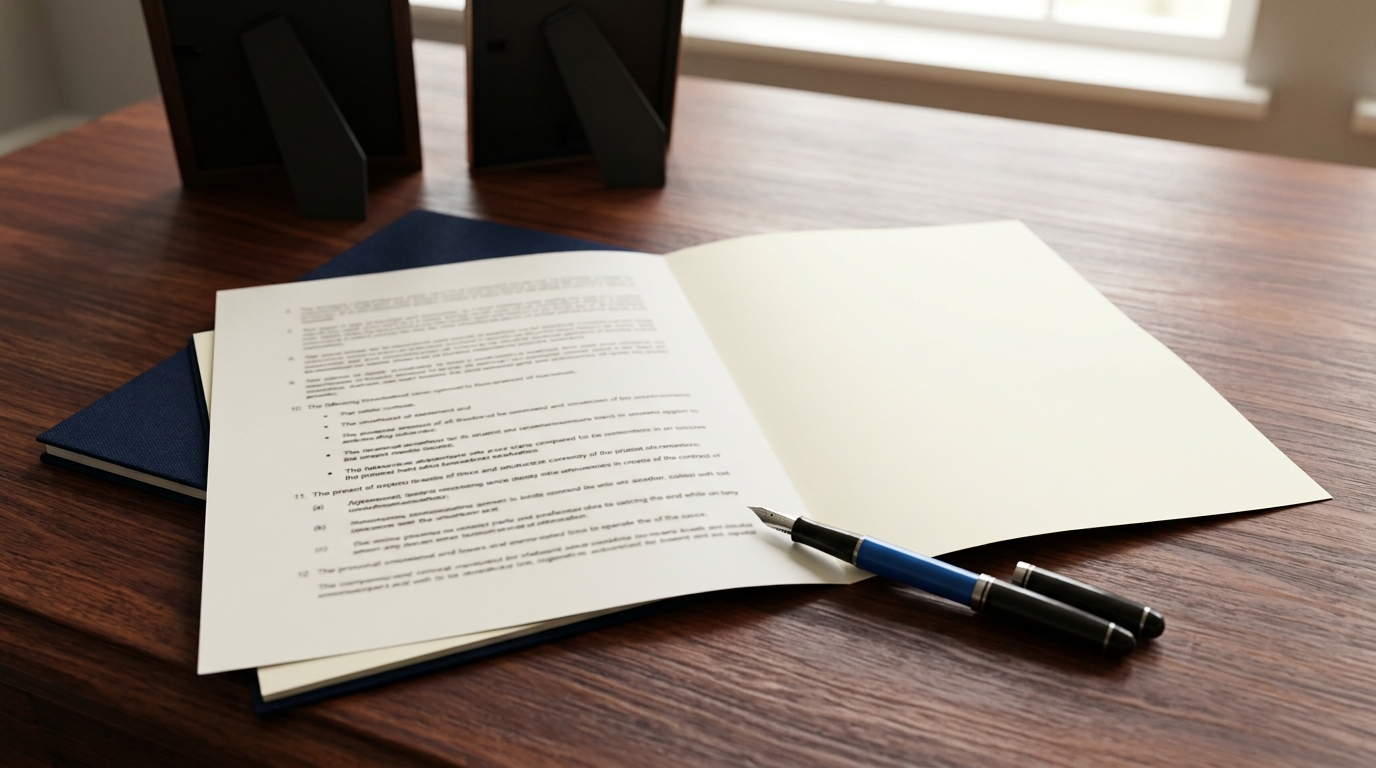
Your Florida Legacy Roadmap: What Your Family Opens First
Financial planner Stacy Francis told a story in Kiplinger last month that lands hard for anyone who has settled a parent's affairs. Her friend Veronica spent nearly a year tracking down her late mother's savings accounts, investment accounts, and insurance policies. Utility bills went unpaid because the statements were hard to find. Veronica had no room to grieve. She had a filing project.
The detail that makes the story sting: Veronica's mother was organized. Meticulous, in every other part of her life. She had simply never written down what she knew. The map lived in her head, and it left with her.
I see this in Orlando, Tampa, and Naples every month. The family has the will. What they do not have is the roadmap.
```An estate plan and a legacy roadmap are two different documents
Your estate plan answers a legal question: who gets what, and how does it get there. A legacy roadmap answers a logistics question: where is it, and who do I call.
Both matter. Only one of them gets opened in the first week.
A roadmap is a plain inventory. Financial accounts and where they are held. Insurance policies and policy numbers. Real property and how title is held. Business interests. Retirement accounts and their beneficiary designations. Your CPA, your Florida estate planning lawyer, your insurance agent, your banker. Digital accounts and how to reach them. That is the document your family needs at 8 a.m. on the worst Monday of their lives, and almost nobody has one.
Florida law adds wrinkles most out-of-state advice misses
National estate planning content is written for a national audience, which means it is wrong somewhere. Often it is wrong here. Three Florida traps come up constantly.
Florida abolished the springing power of attorney.
Many states let you sign a POA that lies dormant until a doctor certifies your incapacity. Florida used to. Not anymore. Under Fla. Stat. § 709.2108(3), a power of attorney executed after October 1, 2011 cannot become effective at a future date or upon a future event. It works when you sign it or it does not work at all.
That matters for the roughly $21 billion in income that moved into Florida in a single year. New arrivals bring the documents their old lawyer drafted, and every Florida bank, title company, and hospital that reads a springing POA will hesitate. Hesitation costs weeks.
Digital assets need express authority.
The Florida Fiduciary Access to Digital Assets Act, Fla. Stat. ch. 740, took effect July 1, 2016. It gives four fiduciaries a path to your digital accounts: personal representatives, guardians, agents under a POA, and trustees. The path opens only if your documents grant the authority. A shared password list is convenience, not authority.
A health care surrogate has execution requirements.
Fla. Stat. § 765.202 requires the designation be signed before two subscribing adult witnesses. It costs almost nothing and it is the omission families regret most.
A hypothetical that is not really hypothetical
A dentist moves her practice from New Jersey to Sarasota. She buys a home, takes the Florida homestead exemption, opens a Florida practice entity, and keeps two New Jersey rentals in an LLC her old lawyer set up. She has a will from 2014 and a springing POA from 2016.
She has a stroke on a Tuesday.
Her husband cannot use the POA, because the bank wants a physician's affidavit the old document contemplates and a current Florida one would not have needed. Payroll runs Friday and nobody has authority to sign. Her CPA's name is in a phone she cannot unlock. The homestead is protected under Article X, Section 4 of the Florida Constitution, which is good news, and completely irrelevant to any problem she has this week.
None of that is an asset protection failure. Her assets are fine. It is a roadmap failure, and it is the more common one.
What to actually do
Start with the roadmap, not the conversation. Most people stall because they are dreading the talk with their kids. Write the inventory first. The document makes the conversation short, because you are no longer discussing feelings. You are handing someone a map.
Then get the Florida documents right. A durable power of attorney that complies with current Florida law. A health care surrogate designation and a living will. Digital asset authority written into the POA and the trust. A revocable trust if probate avoidance matters, funded properly. If you hold investment real estate, a Florida land trust under Fla. Stat. § 689.071 keeps ownership private and pairs cleanly with an LLC for the liability layer. The asset protection strategies Florida investors rely on work best when the roadmap tells the successor how the structure fits together.
Then talk. Where the documents are. Who the advisors are. Who makes medical decisions. What you want.
Frequently asked questions
Does my out-of-state power of attorney work in Florida?
Often, yes. Fla. Stat. § 709.2106 recognizes a power of attorney that did not follow Florida's execution rules, so long as it complied with the law of the state where it was signed. But recognition and acceptance are different things. The same statute lets a third party who is asked to accept such a document request an opinion of counsel first, and rely on it without further investigation. That is a lawyer's bill and a delay, arriving in the week you can least afford either. Re-executing under Florida law is usually cheaper than proving up the old one.
Is a will enough?
A will only speaks after death, and only through probate. It does nothing during incapacity, which is the gap that hurts most families.
Do I need a trust if I have a homestead?
Not necessarily, and homestead has its own devise restrictions when a spouse or minor child is involved. Homestead protection under the Florida Constitution is separate from the homestead tax exemption, and neither one is a substitute for a plan.
Where do I keep the roadmap?
Somewhere your successor can reach without you. A sealed envelope with your named agent, or a password manager with emergency access enabled and the legal authority to match it in your documents.
Next step
If you moved to Florida in the last five years and your documents did not move with you, they are probably not doing what you think they are doing. Book a complimentary discovery call with our Legal Solutions Coordinators, or call 866.725.2818.
Educational only. Joseph E. Seagle is licensed in Florida, and this article addresses Florida law. It is not legal or tax advice, and reading it does not create an attorney-client relationship. Other states treat every issue discussed here differently. Consult a licensed attorney in your jurisdiction.
Download the Florida Legacy Roadmap
Create a clear inventory of the accounts, documents, advisors, property, business interests, and digital assets your family may need to locate during an emergency.
Download the RoadmapNot Sure Where to Start?
Book a complimentary Discovery Call with our Legal Solutions Coordinator to learn how to update your Florida estate plan, incapacity documents, and asset protection structure.
Book a Discovery Call