
Your Estate Plan Is Your Asset Protection Plan: A Florida Business Owner's Guide to Getting the Whole Pie
You've done some planning. But is it connected?
You have an LLC — maybe two. A will, or possibly a trust that was drafted a few years back. You own real estate. Your business has real revenue and assets worth protecting. From the outside, your plan looks solid.
Here's a scenario that plays out in practice more often than most people expect.
Maria’s Structure
Maria is a Florida entrepreneur who owns a medical staffing agency and three rental properties. She has a will, a power of attorney, and one LLC covering everything. She thinks she's protected.
Here's what a review of her structure actually reveals:
- Her LLC holds both her business operations and her rental properties — two completely different risk profiles inside one entity
- Her will means her LLC membership interest will pass through probate when she dies — a public, court-supervised process
- Her rental properties are titled in her own name, searchable by anyone with access to county records
- There's no trust, so if Maria becomes incapacitated, asset management becomes complicated immediately
Maria didn't cut corners. She built her plan in pieces, without anyone connecting them into a whole. This is the most common pattern — and it's fixable.
The four pillars — and why they must work together
Estate planning, asset protection, real estate structuring, and business entity design are not four separate disciplines. They're four components of a single system. When designed together, each reinforces the others. When designed separately — or not at all — they leave gaps. Here's how each pillar works, and how they connect.
1. Estate planning — the structural foundation
A revocable living trust is the cornerstone of sound Florida estate planning for business owners. Unlike a will, a properly funded trust avoids probate entirely. Assets titled in the trust — or where the trust is named as beneficiary — transfer to your heirs on your terms: no court, no delay, no public record.
For business owners, the critical point is this: your LLC membership interests should be owned by your revocable trust. If owned personally, those interests go through probate at death — and during that process, management of the LLC can become murky, delayed, or contested.
A trust also addresses incapacity. If you become unable to manage your affairs, your successor trustee steps in without a court-appointed guardianship proceeding. That continuity matters more than most business owners realize until they need it.
2. Business entity structuring — the operational layer
A properly structured Florida LLC provides charging order protection. If a creditor wins a judgment against you personally, they cannot seize the LLC's assets or force a sale. Under Florida law, their remedy is limited to a charging order — the right to intercept distributions from the LLC if and when made. Since you control when distributions happen, this protection is meaningful.
But it only works when entities are properly structured and separated. The critical mistake: running business operations and holding investment assets in the same LLC. If your agency and your rental properties share an entity, a lawsuit against the business can reach the properties, and vice versa.
Operating LLC for operations. Holding LLC for assets. They should never be the same entity.
3. Florida land trusts — your privacy shield
A Florida land trust holds title to real property while keeping the beneficial owner's name off the public record. Anyone can run a county property search. If your property is titled in your name — or your LLC's name — you're findable. Plaintiffs' attorneys run asset searches before filing suit to determine whether a case is worth pursuing.
A land trust removes your name from that equation. The trust appears as the record owner. Your connection to the property lives in the trust agreement — a private document, not recorded.
4. The integrated structure — where it all comes together
This is where Florida law becomes genuinely powerful for business owners who have all the pieces in place.
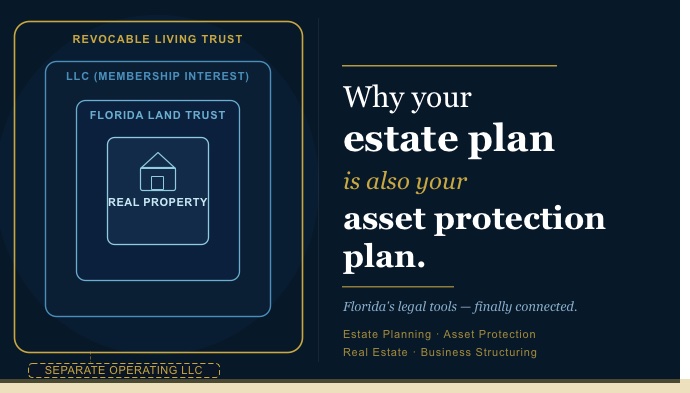
The fully layered structure works like this:
- A Florida land trust holds title to real property — no names in public records
- An LLC is named as the beneficiary of the land trust — the LLC holds the beneficial interest, protected by Florida's charging order statute
- That LLC is owned by your revocable living trust — when you die, membership interests transfer without probate
- A separate operating LLC handles leases, vendor contracts, and day-to-day liability — without touching the asset-holding structure
The result: privacy (land trust), creditor protection (LLC with charging order), probate avoidance (trust ownership), and operational insulation (separate operating entity). Four goals. One system.
The most overlooked gap: coordination
The clients we see most often don't have a bad plan — they have an uncoordinated plan. The estate plan was drafted by someone who didn't know what entities the client had. The LLC was formed by someone who didn't know what the trust owned. The real estate was purchased years ago and never restructured.
The result: a trust that doesn't control anything meaningful, an LLC that probates at death, and a property anyone can trace back to you.
The fix requires someone with a bird's-eye view of all four disciplines — someone who understands how a change in the operating agreement affects the estate plan, how the land trust interacts with the LLC's membership structure, and how all of it flows through the trust at death. This is what comprehensive strategic design looks like.
Frequently asked questions
Do I need a land trust if my LLC already holds the property?
Do I need a land trust if my LLC already holds the property? The LLC provides protection; the land trust provides privacy. Your LLC's name still appears in public records when it holds property directly. The land trust removes that exposure. Both serve distinct purposes.
Will my revocable living trust protect my assets from creditors?
Will my revocable living trust protect my assets from creditors? No. A revocable trust is designed for probate avoidance and incapacity planning — not creditor protection. The protection comes from the LLC structure underneath the trust. The trust owns the LLC; the LLC shields the assets.
Can I consolidate everything into one LLC?
Can I consolidate everything into one LLC? Technically yes. Strategically, no. Mixing your business operations with real estate or investment holdings exposes everything to the same liability pool. Separate entities serve separate risk profiles.
What's next
If you're reading this and recognizing your own setup — pieces of a plan without a whole — that's exactly the kind of gap a comprehensive strategic design assessment is built to address. We work through this process with Florida business owners regularly, and the distance between where most people are and where they need to be is usually smaller than expected. What they needed was someone to see the whole board.
Download THE 4-LAYER PROTECTION BLUEPRINT
A Florida Business Owner’s Complete Asset Protection Structure
Download the Blueprint